
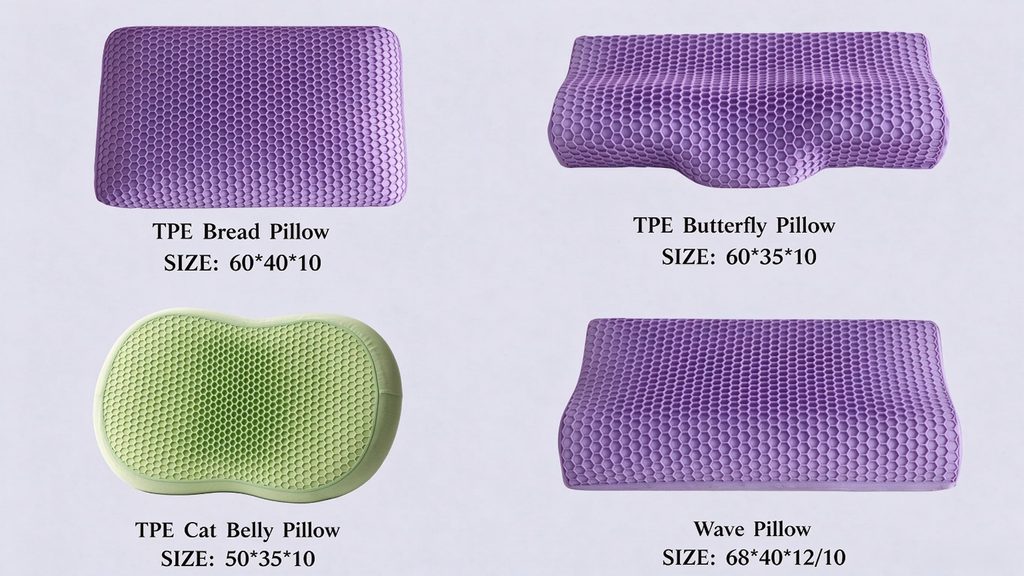
TPE pillows have been everywhere lately — soft, breathable, fully washable. They’re one of our most requested items for the Japanese market, and growing fast in Europe and the US, especially in summer.
But buyers keep telling us the same thing: TPE is great — until you actually need support.
The TPE Trade-off
TPE (thermoplastic elastomer) is loved for being soft and springy, sleeping cool through its open structure, and being fully washable. But the same softness that makes it feel cloud-like is its limitation: it doesn’t hold its shape under weight. For side and back sleepers, the neck can sink into an unsupported position, especially as the pillow flattens over the night.
Who Feels It Most?
Two groups of end-users keep coming up:
People with shoulder or neck discomfort. TPE doesn’t contain the head or hold the cervical curve. For someone already dealing with shoulder strain, “soft” isn’t the same as “supportive.”
People with acid reflux. Doctors often recommend elevating the upper body at night. A soft TPE pillow collapses under the head, so it can’t maintain that angle.
This isn’t a flaw in TPE — it’s a category reality. TPE was never designed to be a supportive foam. It’s an elastic polymer, not a viscoelastic one.
Our Approach: Don’t Choose. Combine.
Rather than choosing between TPE and memory foam, our hybrid build splits the job:
- Outer shell: TPE. Breathable, skin-friendly, removable, washable. The summer comfort people love stays.
- Inner core: zoned memory foam. Underneath, a memory foam core does the support work. We tune firmness by zone so the neck stays aligned rather than dropping.
See the TPE cover and the zoned memory foam core up close in this short video:
Why Zoning Matters — And How We Tune It
A common misconception is that support = a firmer pillow. But a uniform-density pillow presses the shoulders up and bends the neck. Real support comes from three different feels inside one pillow:
- Neck zone (cervical ridge): slightly firmer density. This is the part that holds your neck up. Too soft and it collapses; too firm and it feels like a block.
- Head zone (center depression): softer, slower-rebound. Where the back of your head rests — sinks in gently, holds the shape of your skull.
- Shoulder zone (edges): lower density. When you roll onto your side, the shoulder needs to sink in so your neck isn’t bent upward.
The TPE cover sits on top of all this. It doesn’t interfere with the zoning — it just adds a breathable, washable layer between the sleeper and the memory foam.
Why This Matters for Brands
You can’t sell TPE as a one-size-fits-all solution — a segment of customers will come back saying “too soft.” But you also don’t want to lose the shoppers who love TPE’s breathable feel. A hybrid lets you serve both segments with one SKU.
We currently supply this build to partners across Japan, Korea, Europe, and the US.
If you’d like samples, a spec sheet, or a conversation about zone configurations and cover options, reply to this email or reach us through the contact form.
— AVA, MINCOLEN